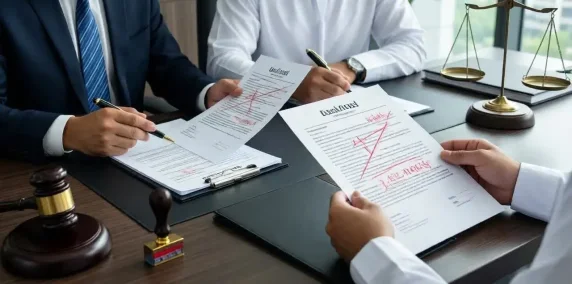
Common Mistakes in Commercial Contracts in the UAE | A Comprehensive Legal Guide
Commercial contracts form the fundamental framework for regulating legal and business relationships between individuals and companies in the United Arab Emirates. However, many disputes arise not due to the absence of a contract, but rather as a result of errors in drafting or a lack of understanding of contractual terms and their legal implications.
In this article, we highlight the most common mistakes found in commercial contracts in the UAE, including both legal and technical drafting errors, as well as mistakes frequently made by non-specialists when dealing with contracts. We also explain their legal consequences and emphasize the importance of informed and careful contractual engagement.
First: Common Legal Mistakes in Commercial Contracts
1. Vague or Ambiguous Contractual Clauses
One of the most common mistakes is the use of general or unclear language when drafting contracts, which opens the door to multiple interpretations in the event of a dispute.
Lack of clarity in defining obligations, timelines, or the scope of liability can lead to complex legal disputes that are difficult to resolve.
2. Omission of Essential Contractual Clauses
In some contracts, the focus is placed solely on the core commercial agreement while overlooking essential clauses such as:
- Contract termination mechanisms
- Penalties for breach
- Jurisdiction or arbitration clauses
- Governing law
The absence of these provisions may significantly weaken a party’s legal position in the event of a dispute.
3. Failure to Align the Contract with UAE Laws
Using standard contract templates or agreements borrowed from other legal systems without adapting them to UAE laws is a common mistake.
A contract must comply with local legislation to be legally enforceable before UAE courts or authorities.
4. Ignoring Future Risks
Some contracts are drafted based only on current circumstances, without considering potential future developments such as:
- Changes in market conditions
- Financial or operational default by one of the parties
- Force majeure events
Failing to address these risks may result in unexpected legal consequences.
Second: Common Mistakes in Understanding Contracts by Non-Specialists
1. Believing the Contract Is a Mere Formality
Some parties assume that a contract is simply a formality required to complete an agreement. In reality, a contract is the primary legal reference that defines:
- Rights
- Obligations
- Legal consequences in case of dispute
Every written clause may create a legally binding obligation.
2. Signing Based on Trust Without Proper Review
In many commercial dealings, contracts are signed based on trust or long-standing relationships between the parties. While trust is important, contracts are not drafted for times of agreement, but rather to regulate relationships in times of disagreement.
3. Overlooking Detailed or Fine-Print Clauses
Detailed provisions or clauses written in smaller print often include:
- Penalty clauses
- Additional obligations
- Contract termination or cancellation conditions
Ignoring these clauses may result in unexpected legal liabilities.
4. Confusing Verbal Agreements with Written Terms
Some believe that verbal agreements are binding even if they are not included in the contract. However, in the event of a dispute, courts generally rely on what is written in the contract rather than what was verbally agreed upon.
5. Failing to Understand the Legal Effect of Signing
Signing a contract constitutes acknowledgment of its contents and acceptance of all its terms, even if the contract was not fully read.
A common misconception is that lack of understanding removes liability, whereas the general legal principle is that signing creates full legal responsibility.
6. Not Seeking Legal Advice Before Signing
Some individuals avoid seeking legal advice, assuming it is unnecessary or costly. In reality, a simple legal review before signing:
- Can prevent prolonged disputes
- Clarify ambiguous clauses
- Protect rights that may later be difficult to recover
The Importance of Engaging a Specialized Contract Lawyer
Engaging a lawyer specialized in commercial contracts helps to:
- Draft clear and balanced contracts Reduce legal risks Protect rights and interests Ensure compliance with UAE laws
This contributes significantly to the stability of commercial relationships and the prevention of future disputes.
Most contractual disputes do not arise due to the absence of a contract, but rather because of poor drafting, misunderstanding of contractual terms, or careless handling of contractual obligations.
Approaching contracts with legal awareness—both technically and practically—is essential to protecting rights and ensuring stable commercial transactions in the United Arab Emirates.
Frequently Asked Questions (FAQs)
What are the types of errors in contract law?
Errors in contract law generally include material errors and substantive (essential) errors.
A material error, such as a clerical or typographical mistake, does not invalidate a contract if the agreement was concluded with full consent and without coercion. Such errors may be corrected through a written amendment signed by the same contracting parties or by correcting the original contract in accordance with legal procedures.
What are the conditions for a valid contract under UAE law?
For a contract to be valid under UAE law, there must be full and genuine consent between the contracting parties. The agreement must be entered into freely, without coercion, threat, fraud, or exploitation of circumstances.
If consent is proven to be defective, the validity of the contract may be challenged before the courts.
What constitutes a breach of contract under UAE law?
A breach of contract occurs when a party fails to perform its contractual obligations as agreed or within the specified time.
Intentional or anticipatory breach is considered a serious violation and may entitle the affected party to claim compensation or seek termination of the contract, particularly in cases involving fraud or misrepresentation.
When does a contract become void or voidable?
A contract is considered void if one of its essential elements is missing, such as consent, subject matter, lawful cause, or the required legal form.
A contract is voidable if the law grants one of the parties the right to request its invalidation, such as in cases of coercion, fraud, or lack of legal capacity.
What is a common mistake in contract law?
A common mistake occurs when both parties share the same misunderstanding regarding an essential element of the contract.
If the mistake relates to a fundamental issue, the contract may be declared void or voidable, depending on the circumstances and applicable legal principles.
What are the types of mistakes in a contract?
Recognized types of mistake include:
- Mistake as to the identity of the contracting party, such as contracting with someone under the assumption they hold a specific role or authority.
- Mistake as to an essential attribute of the contracting party, for example, entering into a contract believing the party is a specific professional, then discovering otherwise.
If the mistake is material and directly influenced consent, the affected party may seek annulment of the contract.